

Magnetic Clasp vs Lobster Clasp: Which Holds Better?
One clicks shut in under a second. The other takes a beat longer to line up, but once it's closed, it stays closed no matter what happens to your wrist next.
A lobster clasp holds more securely under force. A magnetic clasp is faster, easier, especially one-handed, but it separates if the pull is hard enough. Neither wins outright. It depends on what you're asking the clasp to do for you.
The short answer
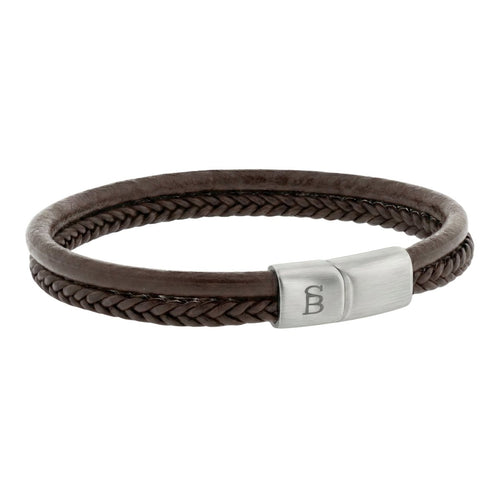
Leather bracelets and bead bracelets usually run on a magnetic clasp. You close it one-handed, no twisting, no squinting at a tiny spring mechanism. Necklaces and heavier pieces in the stainless steel collection lean toward a lobster clasp instead. A chain hangs and pulls straight down all day, and a magnetic closure under that kind of steady tension tends to work loose faster than one that only gets handled twice a day, on and off.
How each clasp works
A lobster clasp is a small spring-loaded lever shaped like a claw. Squeeze it, a gap opens, hook it through a jump ring, let go, and the spring pushes the lever shut again. The only way it opens on its own is if the lever gets physically pressed or snagged. Straight tension on the two ends of the bracelet doesn't touch the lever at all.
Two flat pieces, each with a magnet inside, pulling together the moment they get close enough. No lever, nothing to squeeze. Line the halves up, they snap shut. Taking it off is just as easy: pull them apart and the field lets go.
Security: which one actually holds
Under a hard, straight pull, the magnetic clasp separates first. Not a flaw, exactly, just how it's built to behave. Past a certain amount of force, the field can't hold the two halves together, and they come apart cleanly, nothing bent, nothing broken.
Pulling on the two ends of a bracelet puts force on the lobster clasp's frame and the jump ring, not the lever itself. Something has to actually catch the lever for it to open by accident, not just tension. Lobster clasps show up on higher-value chains and anything you'd genuinely hate to lose.
Catch a bracelet on a doorframe or a piece of gym equipment and a magnetic clasp gives way rather than staying hooked. Worth factoring in if you work with your hands or train regularly, though it's not a reason to keep jewelry on around real machinery. More on that trade-off in wearing jewelry when you work with your hands.
Convenience: which one is easier to use
Fastening a lobster clasp behind your neck, or on your own wrist with one hand, means finding a tiny lever by feel and squeezing it while lining up a jump ring you can't even see. Two-hand job for most people. Genuinely frustrating one if you're dealing with limited grip strength or any kind of dexterity issue.
A magnetic clasp skips all of that. Bring the two halves close and they find each other. Watch bands, medical alert bracelets, plenty of daily-wear jewelry lean on magnets, even though a lobster clasp would technically hold better under load.
Which clasp fits your bracelet
A few practical guidelines, based on what actually goes wrong with each type:
Choose magnetic if you want to put the bracelet on and off with one hand, you're buying for someone with limited dexterity, or it's a leather or beaded piece you're not too worried about losing.
Lobster makes more sense for anything expensive or sentimental, or for a chain, where a sustained, straight pull is the normal way things go wrong. Think necklaces and heavier link pieces in the stainless steel collection.
Own more than one bracelet? Then it stops being either-or. Plenty of men wear a magnetic-clasp leather bracelet for daily comfort and keep a lobster-clasp chain for anything they'd rather not risk. Pairing pieces is its own topic, covered in how to stack men's bracelets.
The clasp mechanism itself doesn't decide whether a piece triggers a nickel reaction. The metal grade does. A magnetic or lobster clasp made from genuine 316L steel should perform similarly on that front either way.
Two clasps, two jobs

FAQ
Do magnetic clasps fall off easily?
Not under normal daily movement. They separate under a hard, direct pull, usually only when a bracelet catches on something.
Are lobster clasps hard to open?
For some people, yes. The lever is small, and reduced grip strength or a dexterity issue can make it a real hassle one-handed or behind the neck.
Can a magnetic clasp affect a pacemaker?
If it applies to you or someone you're buying for, check with a doctor before choosing magnetic jewelry, and lean toward a lobster clasp instead.
Does a magnetic clasp weaken over time?
A well-made one tends to hold its strength for years. What usually gives out first is the hinge, or the leather it's attached to, not the magnet. Regular cleaning helps more than people expect, same routine covered in how to clean your jewelry.
Will a magnetic clasp rust?
Genuine stainless steel resists rust because of the chromium in the alloy. More detail in does stainless steel jewelry rust or turn your skin green.
Ready to pick the right clasp?
Browse all men's bracelets and see exactly which clasp each piece uses before you buy.
Shop all men's bracelets