

What Jewelry Should a Groom Wear? Probably Less Than You Think
Look at the groom's hands in a few dozen wedding albums and a pattern turns up quickly. A band, a watch, and now and then one more piece that had obviously been part of his life long before the proposal. It isn't a rule anyone wrote down, but it holds up. A well-cut suit carries most of the look, and your hands will be in a remarkable number of frames: holding the vows card, taking a ring, wrapped around a glass during the speeches, resting on a shoulder in the family portraits.
So this guide is less about adding and more about choosing. It goes through the band, the watch and the optional extras, plus the small practical problems that show up once the day has been running for a few hours. The ring that sat comfortably at the ceremony and starts squeezing by dessert. The cuff that keeps catching on a thick watch case. The chain that slides round to your collarbone after every hug.
The short list for a groom
Band and watch. A third piece if it means something to you.
That third piece is where your own taste comes in. A narrow leather bracelet you've had on for years, a fine chain under the shirt, a signet ring on the other hand. One of them has room to be seen. Formalwear depends on a few plain elements, a dark jacket, a white shirt, something at the collar, and when two or three extras join in they pull attention in different directions until the ring is just one item among several.
Your everyday habits are a better guide here than any style rule. A man who never wears jewelry shouldn't treat his wedding as the first experiment. Unfamiliar pieces feel odd, odd things get touched, and that touching turns up in the candid shots. For him, band and watch are plenty. A man who's worn the same bracelet daily for ten years faces the reverse situation: the people who know him would notice a bare wrist sooner than they'd notice the bracelet. And for anyone who leaves the wedding wanting to wear a little more, we've written about the best jewelry for a man who never wears jewelry.
Build your wedding-day look
Tap what you plan to wear. The meter shows when the band starts losing the spotlight.
Getting the wedding band right
The band is the piece that really counts. The suit goes back in its bag within a week; the ring, with luck, stays on your hand for decades. That alone should shape the choice. Buy it for Tuesday mornings, not for the photographer.
Its real life is fairly unglamorous. Pressed against a steering wheel. Tapping a coffee mug. Under the tap every time you wash your hands. A ring that's slightly too tight is a small annoyance in week one and a constant one by year three.
Most fit problems start with the measurement. Fingers swell in warm weather, after a couple of drinks, after an afternoon of handshakes, and shrink again when your hands are cold. A morning reading often comes out small. Measure in the evening, repeat it on another day, and use the finger the ring will actually live on, because your left and right hands might not match. Which hand that is depends on where you live and the traditions you follow; our post on left hand or right hand ring placement goes through the customs, and the size chart explains how to measure.
Band width affects all of this. A broad band covers more of the finger and feels tighter than a slim one in the same size. Comparing a 4 mm and an 8 mm ring on the same number can be surprisingly different.
Stainless steel also has a limitation worth knowing before you order: it can't be resized the way gold can. No quick visit to a jeweler to stretch it or take it in. Measure carefully once and you won't have to deal with it again.
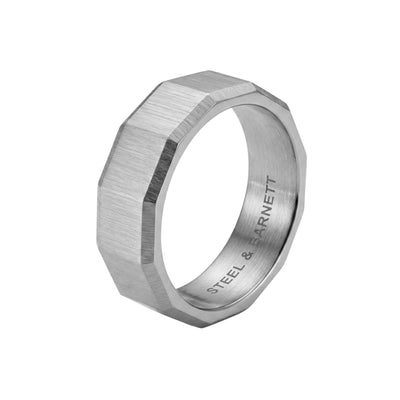
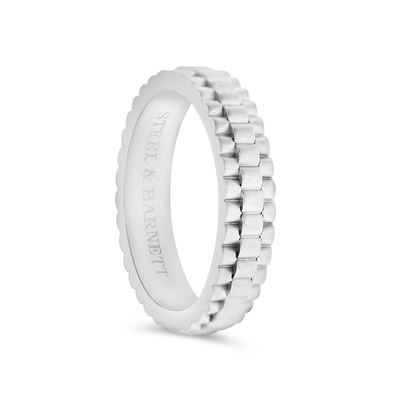
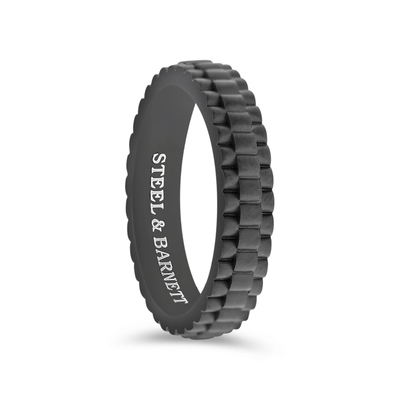
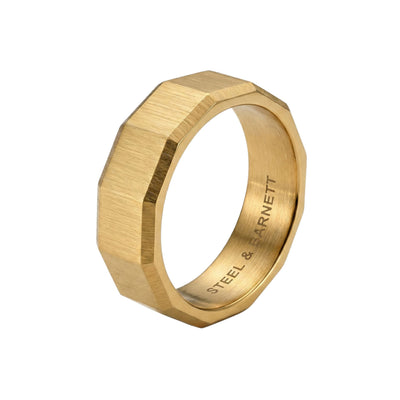
Fit settled, proportion and finish come next. Larger hands carry a wider band well. Slimmer fingers tend to look better, and feel better, with something narrower. As for finish, every ring picks up fine scratches from daily use. Polished steel shows them within weeks, while brushed steel hides most of them in its grain. That's one reason our stainless steel wedding bands are brushed 316L steel. They come in plain steel, black and 18K gold plated, with faceted bands and a watch-link design in the range.
Steel is harder than gold or silver, so it handles ordinary knocks without complaint. Some men wear it as their only band; others choose a precious-metal ring for the ceremony and switch to steel for travel and weekends. Durability is not the same as safety, though. A tougher metal still catches on moving parts, and around machinery a ring of any material is a risk worth removing. Our guide to wearing jewelry when you work with your hands covers that properly.
You won't be wearing the band when you walk in. It goes on during the exchange, so the job beforehand is simply to try it once in the final week, confirm the fit hasn't changed, and hand it to whoever is keeping the rings. Already wear another ring on that finger? Move it across to the other hand until the ceremony is done.
Pick your band tone
Start with the band, then add one extra piece in the same tone.


Watch and bracelet
A watch earns its place on a wedding day. It finishes the outfit, and the day runs on a timetable that people keep checking with the groom.
Case height matters more than brand or style. A slim dress watch tucks under a shirt cuff and stays there. A tall dive watch catches the cuff, shoves it up your forearm and leaves you pulling at your sleeve during the moments that get photographed most: signing the register, reaching for your partner's hand, lifting a glass for a toast. French cuffs give the wrist a little more room than a barrel cuff, though they bring cufflinks along, which is another piece on the tally.
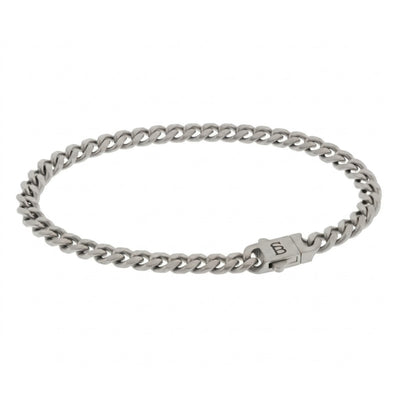
A bracelet can share the wrist with the watch or go on the other arm. In our post on a watch and a leather bracelet on the same wrist we suggest keeping the bracelet narrower than the strap and matching its clasp to the watch case, and that advice carries over to a wedding. Leather in black or dark brown picks up the shoes and belt; our leather bracelets cover both. Wearing a steel watch? Then a fine stainless steel chain bracelet keeps everything in one metal.
Fit makes or breaks it. A bracelet should show just below the cuff and stay roughly where you put it. One that slides onto the back of your hand whenever you raise your arm is simply too big. That's a sizing problem, not a style one, and the size chart covers wrists as well as fingers.
Black tie is, oddly, the easiest dress code to get right. A black bracelet with a black clasp disappears against a dinner jacket and only becomes noticeable to someone standing right beside you, which feels appropriate for the occasion.
Necklaces and signet rings
With a necklace, decide whether it's meant to be seen. A chain that's clearly on show looks intentional, and one that's fully hidden is invisible. The one that flickers at the collar every time you turn your head just looks like it slipped out.
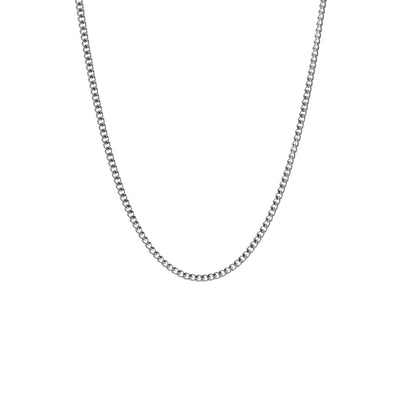
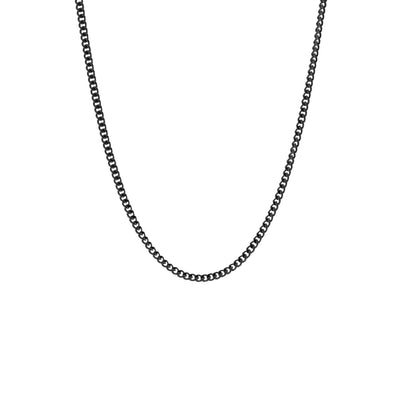
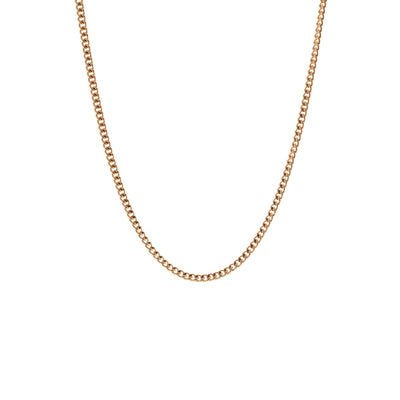
An open-collar summer wedding suits a thin chain at the neck. Put a tie on and the chain vanishes under the shirt, which is fine for something you wear for yourself. In both cases, thin is easier. A plain curb or box chain lies flat and doesn't leave ridges in the fabric, and that's the style we'd point to in our men's necklaces. Pendants need more care. Dress shirts are thinner than they look, and a pendant shows through as a distinct shape, especially in white. Put the full outfit on a week or two ahead and check it in daylight by a window. For chain lengths and styles, see how to wear a necklace as a man.
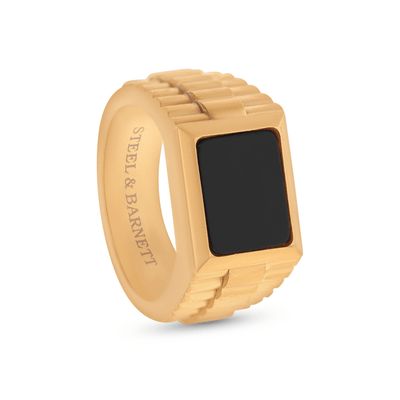
Signet rings sit best on the hand opposite the band. Side by side, the two crowd the exchange and every close-up of your hands for the rest of the evening. Most men who already wear a signet ring daily will want to keep it on. Buying one just for the wedding is harder to justify, though matching it to the band isn't difficult: our signet rings come in brushed steel, black and gold plated with onyx.
Matching metals with your suit and partner
You don't need a scaled-down copy of your partner's jewelry. Keeping the metal colours in the same family does the job.
Gold-toned bands on both of you pair well with one small gold detail elsewhere in the outfit, and gold plated rings are one way to add it. With a steel or white-metal band, a silver-toned watch case and clasp keep things consistent.
Sticking to one tone throughout is the easy path rather than a requirement. A two-tone watch loosens things, since it already mixes both colours. Black steel follows its own logic. It reads almost as a neutral, so it sits comfortably beside plain steel and beside dark leather.
Coordinating beyond the rings is a matter of taste. Some couples enjoy it; plenty never think about it. For the first group, matching bracelets for couples shows how to connect two styles without wearing the same piece.
Mistakes grooms make with jewelry
Wearing something for the first time. Any new piece needs a few days of ordinary wear first. That's long enough to discover a clasp that pinches or a ring half a size off, with time left to change it. A full dress run at home, jewelry included, catches even more. Anyone who's had a reaction to jewelry before should read our post on nickel allergy and men's jewelry before ordering.
Piling it on. Rings on both hands, two bracelets, a chain and a big watch. Any of them might look fine alone. Together they bury the band.
Keeping the ring in your own pocket. Nervous people pat their pockets. Jackets come off for photos and get handed to whoever is nearest. Give the ring to someone dependable early and let them worry about it.
Pieces that won't stay put. A bracelet that keeps rotating or a chain that drifts off-centre becomes something you adjust all afternoon, and in the photos the adjusting is more visible than the jewelry.
Frequently asked questions
Should a groom wear jewelry on his wedding day?
Usually, yes. The wedding band is the main piece, a watch is handy on a scheduled day, and something he wears every day can stay on without looking out of place.
How much jewelry is too much for a groom?
Once you're past three visible pieces, or have anything else on the band hand, the wedding ring starts competing for attention.
Should the groom wear his wedding ring before the ceremony?
No. It's put on during the exchange. Check the fit a few days before, then give it to the best man or ring bearer.
Should a groom's jewelry match the bride's?
It doesn't need to. Similar metal tones are enough to look coordinated, and matching bracelets for couples has ideas for couples who want more.
Can a groom wear a necklace with a suit?
Yes. A thin chain under the shirt works with most suits. A pendant is more likely to show through white cotton than a plain chain, so one of our necklaces without a pendant is the safer pick.
Can a groom wear a bracelet with a watch?
Yes. Choose a bracelet narrower than the watch strap and fitted closely enough that it doesn't slide past the cuff. Slim leather bracelets or a fine steel chain suit this well.
What if the groom doesn't want to wear a wedding ring?
That's more common than people assume. Some jobs make rings unsafe, and some men have simply never worn one. Talk it through with your partner before the wedding. Options include wearing the ring only outside work or on special occasions, wearing it on a chain, or choosing a comfortable steel wedding band for the times a ring is safe to wear.
Start with the band
Brushed 316L steel wedding bands, signet rings and fine chains, made for the everyday wear that follows the wedding.