

How to Store Men's Bracelets So They Last
A bracelet spends more time in a drawer than it ever spends on your wrist. That's usually where the real damage happens.
The fix is different for every material. This guide covers each one, and why.
The Quick Answer
Keep every bracelet dry and out of direct sunlight. Store different materials separately rather than tossing them into one dish together: harder pieces scratch softer ones. Leather needs to breathe, so skip airtight bags and sealed containers. Give steel and gold-plated pieces a little padding so they aren't knocking against other metal. Gemstone beads do best lying flat rather than hanging; the elastic cord wasn't built to carry that kind of weight. The rest of this guide covers each material, and why.
Why Where You Store It Matters as Much as How You Clean It
Cleaning gets most of the attention. Storage is doing quiet damage every single day a bracelet isn't on your wrist, and nobody notices until the piece already looks tired. Heat and humidity are the two biggest culprits. A bathroom shelf has both in abundance, and it's the worst spot in the house to keep any bracelet. Direct sunlight adds a third problem: UV exposure fades certain materials over months, even when nothing else is wrong.
If cleaning is the part you already have covered, cleaning bracelets by material is the natural companion piece to this one. Storage is what keeps a clean bracelet clean.
How to Store a Leather Bracelet
Leather needs room to breathe. Most people protect it the same way they'd protect metal, sealing it in a container or a bag, and that backfires: trapped moisture is what leads to mold, staining, eventually cracking.
Leather wants a cool, dry spot with some airflow. Out of direct sun, away from radiators or heating vents. Lay it flat rather than coiling it tightly, since a tight coil creates a crease that can turn into a permanent crack line over time. Put a leather bracelet away straight after a hot, sweaty day and you're basically doing everything wrong at once. If you condition your leather occasionally, do that before long-term storage, not after.
Our leather bracelets hold up well when you treat them this way, and the moisture question comes up constantly with leather, whether you're wondering about sleeping with a bracelet on or wearing one to the gym: sweat and moisture are the enemy, in storage just as much as on your wrist.
How to Store Stainless Steel and Gold-Plated Bracelets
Stainless steel is close to maintenance-free, but it isn't scratch-free, and the scratches almost always come from other jewelry, not from wear. Throw a steel bracelet in a dish beside a watch and a couple of rings for six months and the finish probably won't look quite as clean. Store steel pieces in their own compartment, not piled against rings or other bracelets, and the finish holds up far better.
Gold-plated pieces need one extra layer of care. The plating is a thin layer over the base metal, and friction wears it thin over time. A soft pouch or a lined compartment matters more here than it does for solid steel.
Steel also holds up better than most people expect around water, something does stainless steel jewelry rust or turn your skin green and stainless steel jewelry in the pool or sea explain in more detail. Storage is still where scratches happen, not water. Set a stainless steel bracelet next to a gold-plated one and the finish difference is obvious right away.
How to Store Gemstone Bead Bracelets
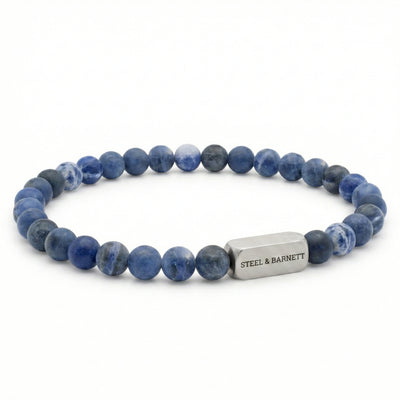
Bead bracelets are strung on elastic cord, and the cord is the part most people forget to think about. Hanging a beaded bracelet on a hook or a stand looks nice on a shelf. It also puts constant tension on the elastic, and that tension shortens its life faster than actual wear does.
Lay bead bracelets flat instead, ideally in a padded compartment where the beads aren't knocking against harder pieces. Heat weakens elastic faster than almost anything else, so keep bead bracelets away from radiators, car interiors, sunny windowsills. Some natural stones can fade slightly with prolonged UV exposure too. That's normal, not a sign anything's wrong. Where that line sits is covered in do gemstone bead bracelets fade or crack.
Our bead bracelets include tiger eye, sodalite, and black onyx, and each behaves a little differently, worth knowing before you decide how to store yours.
One of Each Material


If You Own More Than One Bracelet
Once you have more than one or two bracelets, a shared dish or a pile in a drawer stops working. Bracelets end up scratching each other that way, tangling together into a knot nobody wants to deal with in the morning. A tray or box with separate compartments solves most of the problem on its own.
If a bracelet arrived in its original box or pouch, that packaging is usually built for exactly this, and does the job better than a random drawer would. Our bracelet sets and gift packaging both come with storage-friendly cases if you're starting a small collection and want something better than a drawer from day one.
Store It in Our Own Packaging
The easiest storage upgrade is one you might already have sitting in a closet. Every STEEL & BARNETT box and pouch is built to do exactly this: lined, protective, and shaped to hold a bracelet without letting it scratch or tangle. If you don't have one on hand, both are available on their own.


Common Storage Mistakes to Avoid
The bathroom is still the worst place to store any bracelet: heat, humidity, and steam, day in and day out. Piling every piece into one dish invites scratches, no matter what materials are involved. Storing a bracelet while it's still damp from sweat or a shower, rather than letting it dry first, is how leather starts to smell and steel starts to lose its shine faster than it should.
Sealing leather in a plastic bag traps moisture instead of keeping it out. Hanging bead bracelets by the elastic stretches the cord long before the beads themselves show any wear.
Ready for a Bracelet Worth Storing Properly?
Browse the full range of men's bracelets, from leather to steel to natural stone.
Shop All BraceletsFrequently Asked Questions
Can I store my bracelet in a plastic bag?
Not for leather. A sealed bag traps moisture against the material. For steel, a bag is fine short term, but a pouch or lined compartment is a better long-term choice since it also prevents scratches.
Do I need to take my bracelet off every night?
You don't have to, and most men don't. Material matters here though: leather, steel, and beads hold up differently overnight, and can you sleep with a bracelet on breaks down the differences.
How should I store bracelets when traveling?
Use a soft pouch or a small case with a separate slot for each piece, so nothing tangles or scratches in transit. Avoid tossing loose bracelets into the same bag as a charger cable or anything else that can catch on the elastic or the clasp.
Does gold-plated jewelry need different storage than solid steel?
Yes. Gold-plated pieces benefit from a soft, lined compartment more than solid steel does, since solid steel can handle a bit more contact without visible damage.
Can I store several bracelets in the same box?
Yes, as long as the box has separate compartments or soft dividers. What causes damage isn't proximity, it's direct contact between pieces, especially between a hard material like steel and a softer one like leather or a gemstone bead.
- Choosing a selection results in a full page refresh.
- Opens in a new window.