

Stainless Steel Wedding Bands for Men: Pros, Cons and Who They Suit
Ask an ordinary jeweler to resize a stainless steel ring and the usual answer is a polite no. The metal is too hard for the torch a workshop uses on gold, and the laser or TIG welding that can cut and rejoin it sits with specialist repairers, who may or may not take a particular ring on. It is the one fact about steel that buyers most often learn too late.
The rest of the material’s case is easier to make. The STEEL & BARNETT men’s wedding bands collection is made in 316L stainless steel and every band costs under $100, and the details below, good and bad, relate to those rings.
Why men choose a stainless steel wedding band
Water comes first, as it is the question people ask most. The facet bands are waterproof, heatproof and sweatproof, and showers, washing dishes and sea swimming are all fine. Pool chlorine, bleach and strong cleaners are worth rinsing off, since stainless steel resists corrosion without being immune to harsh chemicals, and drying the ring afterwards takes a few seconds. We cover the same ground for bracelets in can you shower with a stainless steel bracelet and stainless steel jewelry in the pool or sea. Heatproof describes the metal itself, and a sauna still heats any ring against the skin.
Surface wear is slower and less dramatic. Stainless steel does not tarnish, and the marks that appear are fine scratches, mostly from keys, countertops and door handles. On a polished ring they catch the light. On a brushed band, such as the facet designs, they sink into the grain.
Color comes in three versions: the plain steel, a cool, slightly gray silver tone, then black PVD plated and 18K gold PVD plated. PVD is a thin, hard coating, and its limits are covered in the next section.
Price is why most people look at steel in the first place, and under $100 for every band in the collection sits a long way below gold. It also changes how the ring is treated: a ring lost on vacation is an annoyance and not a financial problem.
Skin deserves a plain statement. 316L is a grade widely used for jewelry that sits against the skin all day, and most people wear it without a reaction. Nickel is part of the alloy, though, and nothing about 316L guarantees it will suit someone with a nickel allergy. Our nickel allergy guide for men’s jewelry is the place to start if that applies.
The honest downsides of a steel wedding band
Steel is not an heirloom metal. It lacks the precious-metal resale value of gold and platinum, and a ring meant to be handed down is better made in one of those. Gold is also what some families expect at a wedding, a conversation best had well before the ceremony. The design range is narrower too, as steel does not take fine engraving the way gold does, and the collection runs to facets, brushed textures and link patterns.
Resizing carries the weight of this section. Gold is soft, and a jeweler can cut a band, add or remove metal and solder it closed in a short appointment. Steel does not respond to any of that. Cutting and rejoining needs laser or TIG welding, a few specialists offer it, and whether a given ring qualifies depends on how it is made. Anything with an inlay or a pattern running all the way around the band is the least likely to, as the join would interrupt the design.
Fingers change. Weight goes up and down, hands swell in summer and toward evening, and decades of manual work, or none, leave their mark on the knuckles. A steel ring that no longer fits comfortably is usually replaced, and the replacement is a different ring from the one worn at the wedding.
All of which puts the pressure on the measurement. The rings come in US sizes 9, 10, 11 and 12. Paper or string wrapped around the base of the ring finger gives a length to compare against a ring that fits properly, and late in the day is the time to do it, when fingers are at their largest. A knuckle noticeably wider than the base of the finger needs the band to slide past it and still stay in place, so measure both and expect to compromise.
Black and gold bands are steel with a PVD coating, hard but thin. Edges and the raised parts of a design take the most contact from countertops, steering wheels and door handles, and that is where the coating tends to thin first, leaving silver-toned steel visible. There is no dependable timescale, as it depends on the ring and on what it meets. Plain brushed steel has nothing to wear off.
Steel vs gold, tungsten and titanium
Think through what actually happens to a ring over the years and the four metals separate quickly.
Pick what matters to you:
A hard knock against a doorframe or a curb is the most common event. Gold, being soft, takes the mark and sometimes a dent. Tungsten carbide shrugs off scratches, but it is brittle, and a sharp enough impact can chip or crack it. Steel and titanium mark more easily than tungsten carbide and do not share its tendency to break, though how any individual ring behaves depends on the alloy, the finish and the design.
A change in finger size is the other event, and here gold stands alone, as most jewelers can alter it. Tungsten carbide generally cannot be resized. Titanium and steel can occasionally be altered by specialists, depending on the ring, and nobody should plan on it.
Weight is felt every hour of the day. Titanium is the lightest of the four, and some wearers hardly notice it on the hand. Steel is heavier than titanium and lighter than tungsten carbide, which sits at the heavy end, while gold is dense too, with the effect varying by the width of the band.
Cost and value make the final split. Gold is the most expensive and the only one with precious-metal value, which matters if the ring is meant to be passed on. Stainless steel is the cheapest of the four, and steel and titanium both resist corrosion well, within the limits noted earlier. The 18K plated gold rings give a gold color over steel, with the coating wear described above.
Who a stainless steel wedding band suits
Matching comes up first for couples. A partner’s ring in gold or platinum will not match a steel band in color or finish, and a pair intended to look identical is better made in a single metal. Where the partner is wearing steel too, or the match does not matter, nothing needs resolving. Anyone who already owns stainless steel bracelets will find a steel ring sits well alongside them, and a steel band can also serve as an everyday second ring beside a gold one kept for formal occasions.
Size stability matters more than most of the other points. Someone whose finger size has held steady for years is a safer buyer than someone who has recently gained or lost weight, or expects to.
Rigid metal rings and certain activities are a poor combination. Machinery, tools, ladders, pull-up bars and barbells can all catch a ring, and a snag can pull hard on the finger. The toughness of steel offers no protection from that, and removing the ring, or wearing a silicone one, is what many people do for such work. Sweat and chalk are harmless to the steel itself. Our guide to wearing jewelry when you work with your hands has more on the occupational side.
At under $100 a band is cheap to replace after a loss, and cheap enough to leave at home for the activities above without worrying about it.
How to choose your steel wedding band
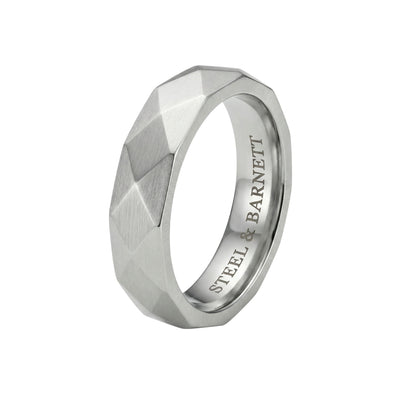
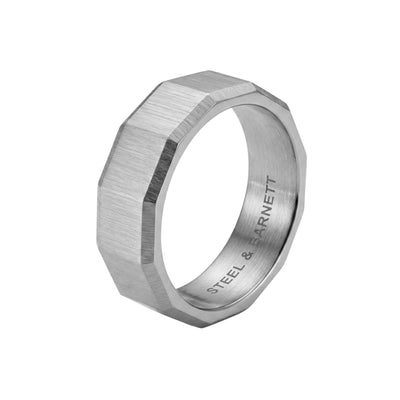
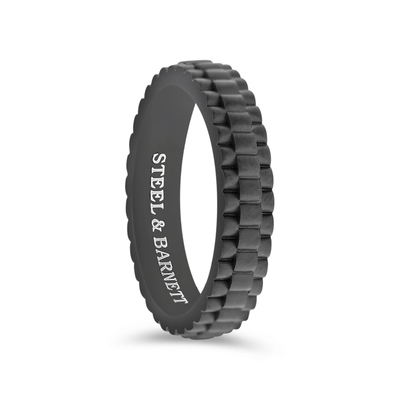
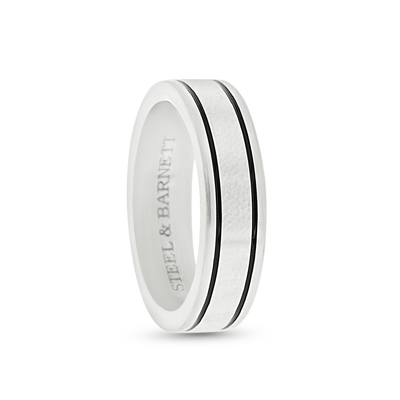
Surface is the main difference between the four rings: three carry a pattern and one has very little. The Facet Band Ring and the Wide Facet Band Ring both cut brushed steel into diamond-shaped planes, the second across a broader band. The Nova Watch Link Ring takes a gear-like texture from watch links and sits naturally beside a watch. The Verto Band Ring is the exception, brushed steel with two parallel black enamel lines and nothing else.
Finish sits on top of that. Brushed steel carries no coating. Black PVD plated and 18K gold PVD plated versions are also available, with the coating wear described above, and the black rings collection shows the darker options together. Size, once decided, is final in practice, so the evening measurement is worth repeating before ordering.
Which hand the ring goes on is covered in left hand or right hand: what your ring placement says, and the rest of the wedding-day outfit is discussed in what jewelry a groom should wear.
Frequently asked questions
Is stainless steel good for a men’s wedding band?
Hard-wearing, low in price and free of tarnish, stainless steel suits everyday wear well. Its costs are limited resizing and a lack of heirloom value, and anyone who values either will want to look at gold or platinum instead.
Can you resize a stainless steel wedding ring?
Rarely in practice. A standard jeweler’s torch makes little impression on steel, and cutting and rejoining a band needs laser or TIG welding that only specialists offer. Even they may decline rings with an inlay or a pattern around the band. Measure in the evening, against a ring that fits, and treat the size you order as the size you keep.
Will a stainless steel wedding ring turn my finger green?
Green skin is the classic sign of copper in a cheaper metal, and genuine 316L stainless steel is not normally in that group. A ring that stains the skin is more likely made of something else or coated, and its grade is the first thing to check. We look at the possible causes in our guide on whether stainless steel rusts or turns skin green.
Can you wear a stainless steel wedding ring in the shower or pool?
Showers and swimming are both within the range of the facet bands, which are waterproof, heatproof and sweatproof. Salt, chlorine and bleach are best rinsed off and the ring dried, as corrosion resistance falls short of immunity to harsh chemicals. The pool and sea guide goes into more depth. A sauna is the exception, as metal rings heat up against the skin whatever the material.
Does a stainless steel wedding ring scratch?
Fine scratches appear on any metal, steel included, and a hard knock can dent it. They show less than on gold, particularly on a brushed band where the grain absorbs them. PVD finishes are the exception worth noting, as the coating can thin at the edges and raised areas and show the steel underneath.
Do stainless steel wedding rings look cheap?
Looks depend on workmanship. Rough edges, uneven brushing and thin plating are the giveaways, and a well-finished faceted or brushed band has none of them. Check the finish up close and confirm the grade, which is 316L here; the full men’s wedding bands collection shows the range.
Brushed, black or 18K gold PVD plated, all in 316L stainless steel.
Browse men’s wedding bands